 Noel D'Costa
Contents
Your AI pilot worked on one line. A year later the second plant still doesn't have it, and the first line has quietly stopped using it.
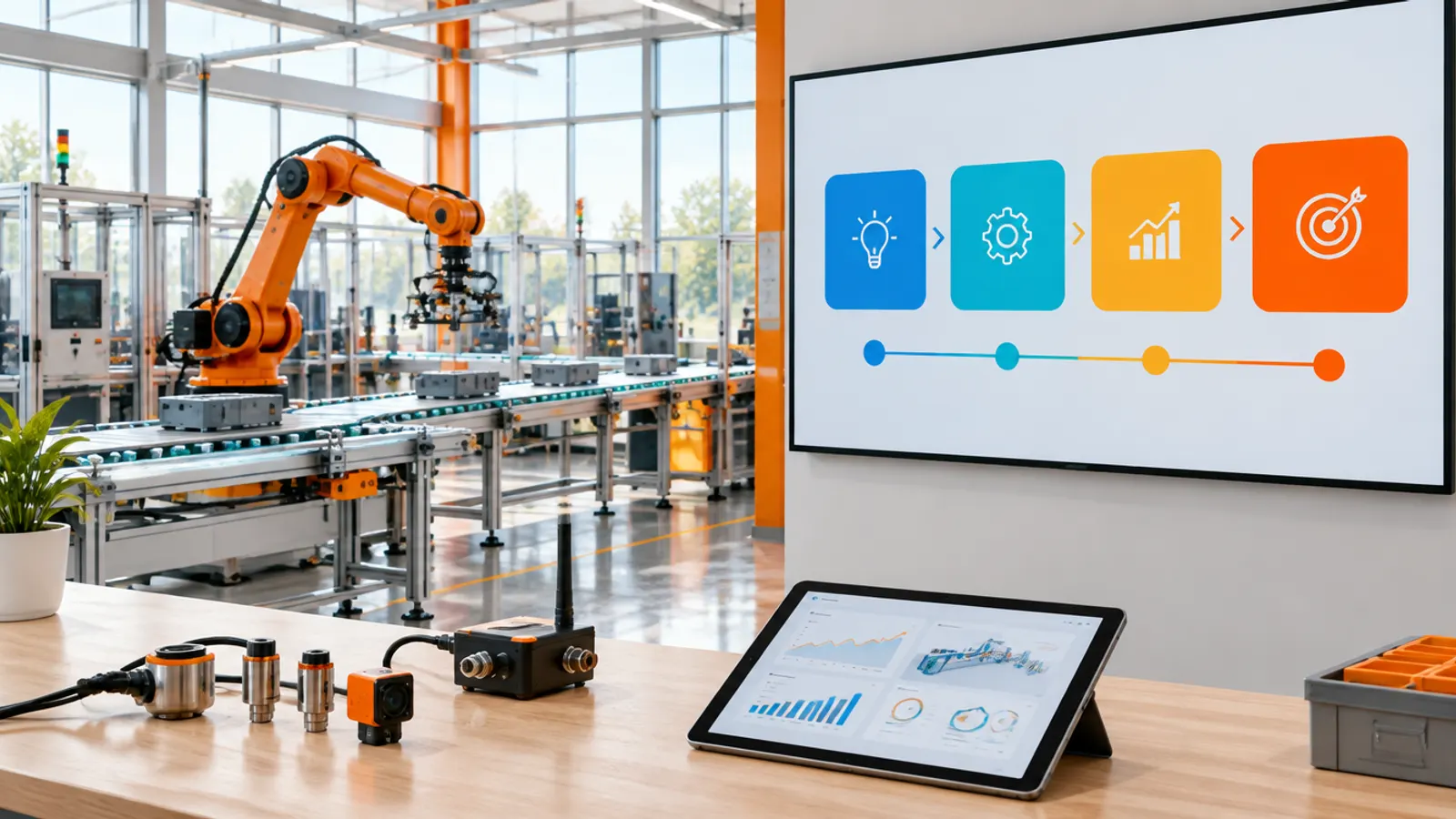
An AI roadmap for manufacturing exists to stop that. It has four stages. Join plant data to ERP data, add a governed intelligence layer, scale AI agents, then build AI into how the factory runs.
Most manufacturers try to start at stage three. That's why the pilots stall.
I've implemented ERP in plastics, steel and defence manufacturing. The pattern repeats. The model is rarely the hard part.
The hard part is that three systems describe the same order in three ways.
Picture one order for 5,000 moulded caps. The ERP sees a production order. The MES (the system that runs the shop floor) sees a job on press 14, and the press only knows cycle counts.
This roadmap works whatever your core is: SAP, Oracle, Microsoft, Infor or something built in-house.
Here's how I'd lay out the three years.
Three years, four stages
Now: data foundation
Plant, quality and ERP data in one governed platform, with lineage and self-service reporting.
Year 1: governed intelligence
One business language for plants, lines, materials and orders, AI governance, and the first quick wins.
Year 2: scale AI agents
Agents for maintenance, quality, planning and procurement, running across plants.
Year 3: AI embedded at scale
AI inside how the factory plans, runs and improves, with people and agents working together.
Treat the timing as a guide. A group with ten plants on four ERPs will need longer in stage one.
Factory data lives in layers, and the ISA-95 standard describes them well. At the bottom sit sensors and PLCs, the controllers that run each machine. Above them are SCADA screens and historians (databases of machine readings), then the MES, and on top the ERP that plans and costs it all.
AI needs those layers to talk to each other. In most plants they don't.
I'd start with three things.
- A data platform, usually a cloud lakehouse or warehouse, that takes ERP data, MES records and historian readings. Most use cases need summaries, such as average melt temperature per batch.
- Governance from day one: a data catalogue, lineage that shows where each number came from, and quality rules. If nobody can say where a scrap figure came from, nobody will trust a model that predicts it.
- Self-service reporting. Plant managers should see OEE (good output against possible output), scrap and schedule adherence from one source before any AI is involved.
The hardest work is master data. Take a plastics group with two plants.
Plant A calls a black polypropylene granule MAT-1001 and counts it in kilos. Plant B calls it PP-BLK-25 and counts it in 25 kg bags. Ask a model to forecast resin use and it sees two unrelated materials.
The fix is dull. A material owner maps the codes, agrees one unit, and the platform applies that rule every night.
The tool can suggest the match. A person still decides which code wins and who owns the rule from then on.
Clocks are the other one I'd check early. A rolling mill's historian may log furnace readings in local time while the ERP posts in UTC.
You want to link a surface defect on coil 4471 to the furnace temperature when it was rolled. If the clocks sit four hours apart, the model learns from the wrong temperature. Fix it once here and every later use case gets it right.
- Machines and historiansSensor readings, summarised per batch
- MESJobs, downtime and scrap
- ERPOrders, materials and costs
- Landing zoneRaw copies, kept as they arrived
- Cleaned and mappedOne material code, one unit, one clock
- Self-service reportsOEE, scrap and schedule adherence
One trusted version of every order, from machine to ledger
Year one turns that data into something AI can use safely. The core is a semantic layer: one shared business language for plants, lines, work centres, materials, orders and defects.
Ask an agent about "line 3 downtime" and it needs to know which line 3. Plant A and plant B may both have one, and count downtime differently.
One plant starts the clock when the machine stops. The other starts it when the operator logs the stop. The semantic layer writes down one definition, and every report and agent uses it.
Put AI governance in place the same year. Keep a register of every AI use case, each with a named owner, a risk rating and a point where a person checks the output.
If an AI system becomes a safety component of a machine, the EU AI Act treats it as high-risk. Bring your safety engineers in early. I want them in the first workshop.
Then deliver two or three quick wins people on the floor will notice. Here's a maintenance copilot on a night shift.
- A technician faces a hydraulic press that keeps faulting on low pressure. She types the fault code and the press number into the copilot on a tablet.
- The copilot searches the press manual and past work orders for that press.
- It answers that the same fault came up twice before, both times a worn seal on the main cylinder.
- It gives the seal's part number and links the manual page with the change procedure.
She still decides whether to stop the press, and she still applies the lockout herself. The copilot just cut out the hunt through old paperwork.
Shift handover summaries are the second quick win. At 6am the incoming supervisor gets one page built from MES events, downtime logs and quality holds. Press 9 lost 40 minutes on a slow mould change, and batch 2207 is on hold for short shots.
The supervisor checks the hold and decides what to run first.
A third option is supplier document checks. If a coil's mill certificate says S275 and you ordered S355, the AI flags it before goods receipt. Someone in quality still accepts or rejects the coil.
This is how I'd rank the first candidates.
- Supervisor asksWhy did line 3 lose time last night?
- Semantic layerWhich plant, which line, which downtime rule
- Governed dataDowntime log, MES events, work orders
- Copilot answersWith the source of every figure
- Supervisor checksAccepts, corrects or escalates
An answer the plant manager and the board pack agree on
- Autonomous scheduling
- Vision quality inspection
- Maintenance copilot
- Supplier document checks
- Shift handover summaries
- Generic chatbot
- Later
- Plan
- Start now
Most factories have a data problem, and AI is very good at making it visible.
Year two moves from assistants to agents. An assistant answers a question. An agent watches a signal, decides what to do within limits you set, and acts in your systems.
These are the agents I see paying back first in manufacturing.
- Predictive maintenance. Machine readings trigger a work order in the ERP before the failure, with spares reserved.
- Quality. Vision inspection flags a defect, and the agent holds the batch, links it to the process settings and opens a deviation.
- Planning. The agent rebalances the schedule when a machine goes down or a material is late, and asks a planner to approve.
- Procurement. It chases late deliveries and drafts the expedite request.
Here's how a maintenance agent handles a failing bearing on a stamping press.
- Vibration on the main bearing creeps up over two weeks, and the temperature follows.
- The agent compares the pattern with past failures on the same press type and finds a match.
- It raises a maintenance notification in the ERP, checks that a spare bearing is in stock and reserves it.
- It proposes a slot in Saturday's planned stop and sends the request to the maintenance planner.
The planner approves the slot or moves it. The agent can raise and reserve on its own, but it can't stop a line, and a named person owns that limit.
Now take the planning agent. On Tuesday afternoon an extruder goes down until Thursday, and a container of resin is stuck at the port.
The agent checks open orders, due dates and which lines can make which products. It builds two options. Move three orders to line 2 with overtime on Wednesday, or push one customer order back two days.
The planner picks one, or rings the customer first. I'd never let an agent quietly move a customer date.
The bigger change in year two is ownership. Someone has to own each agent, its limits and its results. I treat agents like new team members, with a job description and a regular review.
- WatchVibration, temperature and current on every press
- DetectA bearing reading drifts out of range
- PrepareWork order drafted, spare part reserved
- ApproveMaintenance planner books the slot
- ActOrder released, technician dispatched
- LearnThe outcome feeds the next prediction
One owner per agent, with set limits
By year three AI isn't a separate project any more. It sits inside planning, production, quality, maintenance and costing.
Here's what that looks like in a monthly S&OP cycle, where sales, production and finance agree one plan.
- Customers share forecasts, and the agent flags the ones that look too high against order history.
- Suppliers share capacity, so the agent sees that your coating supplier is full in March.
- The agent drafts a plan that fits both and costs it in the ERP.
- The meeting spends its hour on the few real trade-offs.
People still own the plan. The head of operations signs it, and finance checks the margin.
Costing is the other place I'd look. Say a moulding machine keeps running slower than its standard cycle time. The agent spots the gap, works out the cost effect and asks the cost accountant whether to update the standard.
The accountant decides, because a standard cost change flows into stock valuation and margins.
- Plant directorOwns the plant targets and the agent portfolioAI governanceRegister, testing and a kill switch for every agent
- Production managerApproves schedule changes the agents propose
- Maintenance agentOwned by the maintenance manager
- Quality agentOwned by the quality manager
- Planning agentOwned by the planning lead
- Procurement agentOwned by the buyer
- AI agents and copilotsMaintenance, quality, planning and procurement agents, with human approval points
- Governed intelligence layerSemantic model of plants, lines, materials and orders, plus the AI register
- Data foundationLakehouse with ERP, MES and historian data, catalogue and lineage
- Plant and enterprise systemsSensors, SCADA, historians, MES and the ERP
Four things don't belong to one year. They run through all of them.
- OT security. OT means the controllers and networks that run machines. Connecting them to cloud AI widens the attack surface, so design the link to IEC 62443 and keep control networks segmented. The agent reads a copy of historian data and never writes to a PLC.
- Sovereignty. Defence, government and some export-controlled work needs in-country or on-premise AI options. Decide which data may leave the plant before you choose a model. A drawing for a defence part may never go near a public model, while a resin forecast probably can.
- An open, multi-vendor stack. Use open formats and standard interfaces such as OPC UA, a common standard for reading machine data. Then you can swap models without rebuilding.
- Your people. Train planners, engineers and technicians to work with agents. A planner who trusts the agent's options uses them. One who doesn't rebuilds the plan in Excel.
The most common failure is a pilot that can't scale. A vision model trained on one line, with data pulled by hand, proves the idea and nothing more.
Take it to the second plant. The cameras differ, the part numbers don't match and nobody owns the model.
The second failure is treating AI as an IT project. If production, quality and maintenance leaders don't own the use cases, the agents get built and then ignored.
My advice is to start with processes. Map how a work order or quality hold moves today, then choose the system. Give each use case a business owner before anyone writes code.
- How it goes wrong: A pilot on one line with data pulled by handWhat works: A data foundation built for every plant
- How it goes wrong: IT builds it and the plant never owns itWhat works: A production, quality or maintenance owner for each use case
- How it goes wrong: Codes, units and clocks fixed again in every projectWhat works: Master data fixed once, centrally
- How it goes wrong: Agents with no owner, no limits and no reviewWhat works: Each agent with an owner, limits and a regular review
Want to test this against your own plants? Book a call and bring one use case plus a rough sketch of your ERP and MES. I'll tell you which stage you're really at and what I'd do first.
What is an AI roadmap for manufacturing?
It's a staged plan for using AI across a manufacturing business. It starts with a data foundation that joins plant and ERP data. Then come a governed intelligence layer, AI agents, and AI built into how the factory runs.
Where should a manufacturer start with AI?
Start with data. Join ERP, MES and machine data in one governed platform, fix the master data, and give plant managers self-service reporting. The first AI use cases come in year one, on top of that foundation.
Which AI use cases pay back first in manufacturing?
Maintenance copilots, shift handover summaries and supplier document checks are quick to deliver. Predictive maintenance, vision inspection and schedule rebalancing deliver more but need better data, so they usually come in year two.
How long does an AI roadmap for manufacturing take?
I plan it over three years once the data foundation is under way. Year one adds the intelligence layer, year two scales agents and year three builds AI into key processes. Quick wins should show value within the first year.
Do we need to replace our ERP or MES before using AI?
No. AI sits on top of your existing systems through the data foundation. What matters is that your ERP and MES data is clean and connected, whichever vendors you use.

Written by
Noel D'Costa

Retail AI roadmap: from clean data to AI agents
Most retailers have plenty of data and little trust in it. This retail AI roadmap fixes product, stock and customer data first, then adds governed AI, agents for forecasting, pricing and service, and AI across the business.

AI strategy for banks: a three-year roadmap
Bank AI pilots often stall in model risk review. This roadmap avoids that in four stages, from governed customer data to agents for onboarding, credit, fraud and AML, with worked examples from retail, SME and corporate banking.

AI roadmap for insurers and wealth managers
Insurers and wealth managers keep most of what they know in documents. Here is how I plan AI for them over three years, with worked examples from claims, underwriting and advice.

Unity Catalog in Databricks: governance set up properly
Unity Catalog is the governance layer for everything in Databricks: one place to control access, track lineage and prove who touched what. Here is how it works and how to design it so it still makes sense in year three.
Next step
Running an ERP programme right now?
If this article touched on a programme you are live in right now, a 30-minute conversation usually gets further than another week of internal analysis.