 Noel D'Costa
Contents
- What each one involves
- When each is the right choice
- Where rollouts go wrong
- A template forced on local teams
- Localisation found in testing
- Master data that does not line up
- Training that explains the global system, not the local one
- What changes when the template runs on RISE or GROW
- Rollout readiness checklist
- Two examples
- Frequently asked questions
An SAP implementation builds the system where none exists. A rollout takes an SAP system that already runs somewhere in the group and extends it to a new country, entity or business unit. Most people assume a rollout is just a smaller implementation. That assumption causes more rework on these programmes than any technical decision.
I once let a CFO believe a regional SAP rollout would be plug-and-play. I explained the risks but did not insist. We were using a global template, and he assumed every location would fall in line without much effort. It did not work that way. One region needed extra tax handling. Another had mandatory employee data fields because of local laws. What looked like a copy-paste job needed real customisation.
So the choice changes how you resource, budget and run the work. Get it wrong and the system may still go live, just not the way you planned.
An implementation starts from zero. You define scope, map processes, configure, migrate data and build integrations. It applies when an organisation has no SAP, or replaces a legacy system outright.
A rollout reuses a design that already works: processes, configuration, master data standards. The work is the gap between that template and what the new location needs. Tax, statutory reporting, currencies, languages, local integrations and the people who will use it.
- Local usersTraining adapted to the local process, in the local language
- Local integrationsBanks, tax filing and logistics systems in the new country
- Local dataCustomer, vendor and material data mapped to the global standards
- Local requirementsTax, statutory reporting and mandatory fields. Requirements only, not preferences
- Global templateProcesses, configuration and master data standards that already work
This is how the two compare in practice:
| Area | SAP implementation | SAP rollout |
|---|---|---|
| Starting point | No SAP, or a legacy system being replaced | SAP already running at headquarters or another entity |
| Design | New design, fit-to-standard | Global template with controlled local deviations |
| Typical duration | 12 to 24 months, longer for large groups | 6 to 12 months per location |
| Main risk | Unknowns across every workstream | Localisation and local readiness |
| Data | Full load from legacy systems | Local data mapped to global master data standards |
| Testing | Full cycle: unit, integration, UAT, performance | Localisation, local interfaces, UAT |
| Change management | Full programme from zero | Existing materials adapted to local teams |
An implementation fits when:
- The organisation has never used SAP.
- The current system is failing and needs replacing as a whole.
- A merger, acquisition or new operating model means the old design no longer fits.
- An industry solution is coming in for the first time, such as SAP for Utilities or SAP for Public Sector.
- No existing template covers the scope you need.
Implementations take longer and cost more up front. You get a design that matches your business and a team that understands every choice behind it. Companies that rush through requirements end up spending 30 to 50 percent more fixing mistakes later. I have seen it happen over and over.
A rollout fits when SAP already runs well somewhere in the group, the core processes are stable, and the template is flexible enough to take local requirements without breaking. If any of those three is shaky, fix the template before you roll it anywhere.
The technical side usually finishes on time. The delays come from people and from assumptions that do not hold in the new country.
A template forced on local teams
What worked well for North America may fall short in Asia or the Middle East. Tax structures, approval workflows and data entry rules differ. I once worked with a company that assumed its European template would work in the Middle East. It caused delays, rewrites and plenty of tension. The business processes were simply too different.
The fix is to give the new location a business owner with authority to make decisions. Headquarters teams deciding processes for places they do not understand produce designs that fail on contact with local users.
Localisation found in testing
Tax handling, statutory reports and mandatory data fields have to be confirmed before design starts. I once supported a client where a simple tax configuration difference delayed their go-live by over a month. It was not about technology. Nobody had validated local needs early enough.
Master data that does not line up
Product codes, customer numbers and vendor classifications have to match global standards. Mismatches found after go-live are expensive to fix and break consolidated reporting. Map local data to the global model during design, not in UAT.
Training that explains the global system, not the local one
Rollouts tend to reuse training from the original implementation. That material explains how the system works at headquarters. It does not explain the local adaptations. Users who do not understand why their version differs will build workarounds.
The framework above still holds. The deployment model of the template changes some of the economics and the extension rules.
On RISE with SAP (Private Edition), each new country adds users to a subscription priced on full user equivalents (FUEs). You get predictable cost and less infrastructure work. The cost also keeps running after go-live, so compare options over several years, not just year one.
On GROW with SAP (Public Edition), check first whether SAP delivers a local version for the country. SAP listed local versions for 59 countries and regions as of February 2024. For other countries, SAP's localisation as a self-service programme lets partners build a customer local version with the Configuration Localization Tool, currently through an early adopter route (SAP Learning). If neither applies, you have a scoping problem, not a rollout.
Clean core applies to every local deviation. Public Edition only accepts extensions through released interfaces. On Private Edition it is a governance choice, but each local modification you allow is one more object to retest at every upgrade, multiplied by every country. The discipline I push for is simple: tax laws, statutory reporting and regulatory mandates justify a deviation. Local preferences do not.
The technical side usually finishes on time. The delays happen when local teams are not ready or when assumptions from the original implementation do not hold in a new country.
Before you commit a date for the next country, get a yes on each of these. Each has an owner.
- Local business owner (new country): named, with authority to sign off the local design.
- Tax and legal advisor: tax, statutory reporting and mandatory data fields documented before design starts.
- Template owner (headquarters): list of proposed deviations, each marked requirement or preference.
- Data lead: local customer, vendor and material data mapped to the global standards.
- Integration lead: local systems that must connect, such as banks, tax filing or logistics, identified and scoped.
- Change lead: training adapted to the local process, in the local language, with local examples.
- Programme director: one location at a time, with lessons from the last go-live fed into the next.
My scope template guide helps with item 3, and the project charter guide covers how to write decision rights down.
A greenfield implementation in Egypt. A regional manufacturing company based in Egypt was stuck with old, disconnected systems and a lot of manual work. Supply chain, production tracking and financial reporting did not talk to each other. They implemented SAP S/4HANA from scratch and connected finance, procurement and production in one system. They set up automated supply chain planning and trained over 5,000 employees in four countries before going live. They did not rush it. They cut operational costs by 25 percent and forecasting errors by 35 percent.
A rollout to 15 markets. A retail company already had SAP S/4HANA running at headquarters and needed it in 15 new markets. Each had different tax rules, currencies and business practices. They started from a global template, adjusted it per location, rolled out in phases over two years rather than all at once, and built training for each region. The result was faster financial consolidation, real-time inventory tracking across stores and 20 percent more accurate reporting at group level.
One was building something that did not exist. The other was extending something that worked. Neither was plug-and-play. If you are at the start of the first kind, my guide on how to start an SAP implementation right is the place to begin.
What is the difference between SAP implementation and SAP rollout?
An implementation builds SAP from zero: requirements, process design, configuration, data migration, integration, testing and go-live. A rollout extends an existing SAP system and its global template to a new country, entity or business unit. The rollout work is the gap between the template and local needs: tax, statutory reporting, language, local integrations and training.
When should a company choose implementation over rollout?
Choose an implementation when there is no SAP to extend or a legacy system is being replaced as a whole. It is also the better route when the business model has changed enough that the existing design no longer fits, or when no template covers the required scope. Forcing a rollout of the wrong template creates more rework than a clean design.
How long does an SAP rollout take compared to an implementation?
An implementation typically takes 12 to 24 months, longer for large groups. A rollout typically takes 6 to 12 months per location, depending on localisation, integrations and data. The biggest variable is how well local requirements were validated before design started.
What are the biggest challenges in a multi-country SAP rollout?
Four come up again and again. Templates forced on local teams without their input. Localisation requirements found during testing. Master data that does not match global standards. Training that explains the global system instead of the local one. Most are people and planning problems rather than technical ones.
Is an SAP rollout always cheaper than a full implementation?
Usually, because the design already exists and is proven. The saving shrinks when a country has complex tax or payroll rules, needs several local integrations, or has poor data. Under RISE with SAP the subscription for each new country continues after go-live, so compare costs over several years.
How does a global template work in an SAP rollout?
The global template is the documented, configured SAP design for the group's standard processes. Each rollout starts from it and adds only the local changes that are genuinely required. Every deviation creates a maintenance obligation at each upgrade, so govern them: requirements such as tax law justify a deviation, preferences do not.

Written by
Noel D'Costa
SAP implementation timeline planning: 5 mistakes to avoid
Most SAP timelines fail before configuration begins. This guide gives phase durations, exit gates and planning ranges by deployment model, and the five mistakes I see behind most overruns.

SAP performance testing: what IT leaders must know
SAP performance problems are almost always predictable and almost always found after go-live. Test for them from design onwards, against criteria agreed before the first run.

Best SAP implementation strategies to avoid costly mistakes
SAP implementations rarely fail because of the technology. They fail because the strategy does not fit the business, or the team cannot hold the discipline behind it.
SAP implementation templates: a phase-by-phase guide
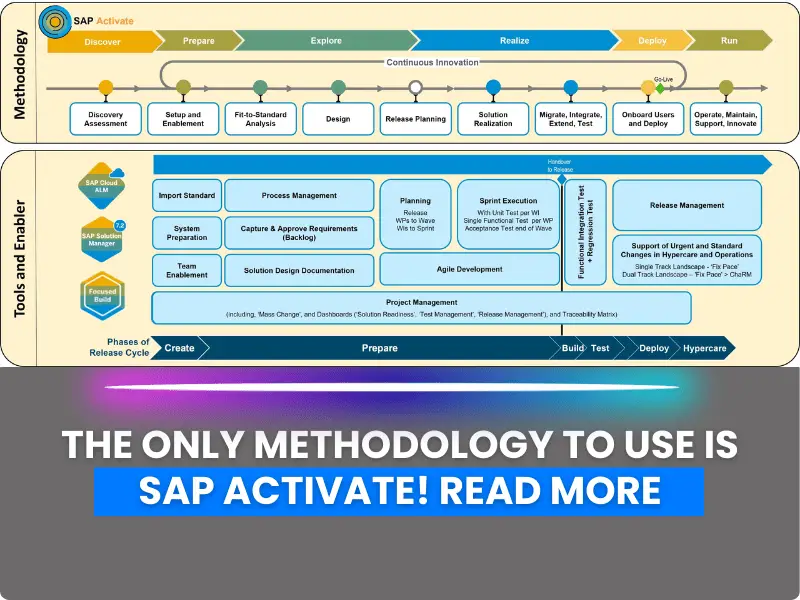
The SAP Activate templates that matter in each phase, from scoping and fit-gap to cutover and hypercare, with layouts you can copy. Teams that skip the Prepare templates pay for it in Realize.
Next step
Running an ERP programme right now?
If this article touched on a programme you are live in right now, a 30-minute conversation usually gets further than another week of internal analysis.